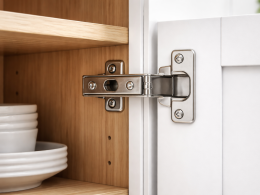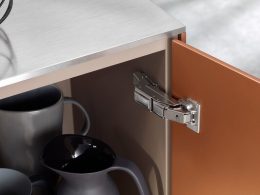

Installing concealed cabinet hinges looks intimidating. It is not. Most homeowners finish a full set of kitchen cabinet doors in an afternoon.
You need a drill, a 35mm bit, a screwdriver, and about 20 to 30 minutes per door. The hinges do the rest.
Once they are on, three screws let you move each door side to side, up and down, and in and out until every gap is even and every door closes with a quiet, controlled click. If something is slightly off, you fix it in seconds without removing anything. That is the entire advantage of concealed hinges over every other type.
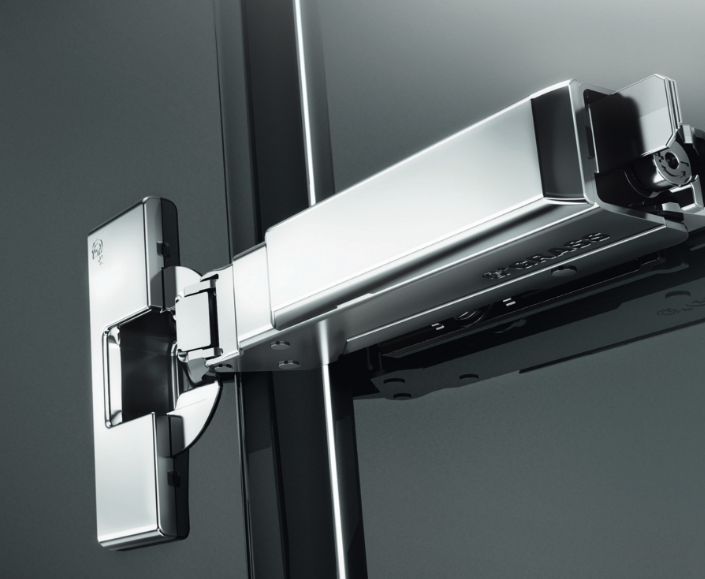
This guide walks you through the process using three of the most trusted brands in professional cabinetry: Blum, Grass TIOMOS, and Salice Silentia+. All three are available at Wurth Louis & Company.
What You Need to Know Before You Buy
Two decisions determine which hinge you need. Get these right and the rest is straightforward.
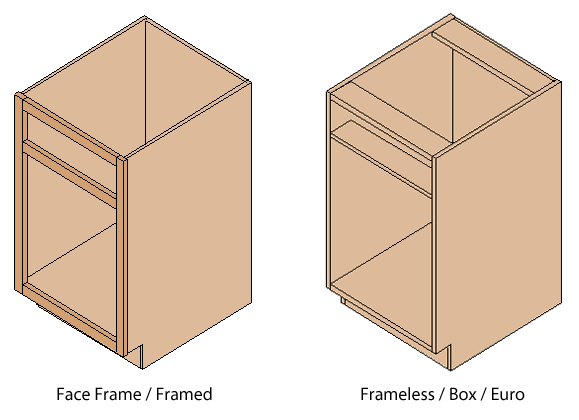
Face Frame or Frameless?
This is the most important question you will answer before buying. Here is how to tell in 30 seconds without measuring anything.
Open a cabinet door all the way and look directly at the inside edge of the opening. Run your finger along the inside wall of the cabinet. If you feel a flat wood border framing the opening before you reach the interior of the cabinet box, you have a face frame cabinet. This border is typically 1 to 1.5 inches wide and is a separate piece of wood attached to the front of the box. Face frame cabinets are the traditional American style and are extremely common in homes built before 2010.
If your finger goes straight from the door opening to the interior wall with no raised border, you have a frameless cabinet, also called a European-style cabinet. The door attaches directly to the side wall of the cabinet box. Frameless cabinets are common in modern, contemporary, and Ikea-style kitchens.
This matters because it determines which mounting plate you order. A face frame hinge uses a plate that clips over or screws into the face frame. A frameless hinge uses a plate that mounts directly to the interior cabinet wall. The hinge cup and installation process are identical between the two. Only the mounting plate differs.
If you are still unsure after the finger test, photograph the inside of your cabinet opening and bring it to the Wurth Louis & Company team. They can confirm your cabinet type and match the right plate in under a minute.
What is Your Cabinet Door Overlay?
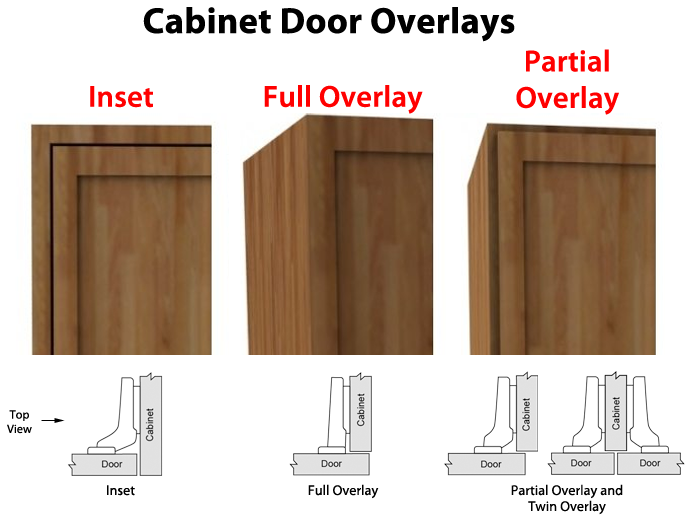
Overlay is how much your door covers the cabinet opening on the hinge side. Hold a ruler against the door edge and measure how far it overlaps the frame or cabinet wall.
Full overlay doors cover most of the opening. Half overlay doors share an opening with an adjacent door. Inset doors sit flush inside the frame. Each overlay type requires a specific hinge arm configuration called a crank. Ordering the wrong one means your door will not sit right.
Tools You Need
- Cordless drill
- 35mm Forstner bit (required for all three brands)
- 1/8″ (3mm) drill bit for pilot holes
- #2 Phillips screwdriver
- #2 POZI driver (recommended for adjustments on all three brands)
- Tape measure
- Pencil
- Combination square or straightedge
A hinge jig is optional but worth the investment if you’re doing more than two doors. It sets your cup hole position automatically so every hole lands in exactly the same spot.
How Many Hinges Does Your Door Need?
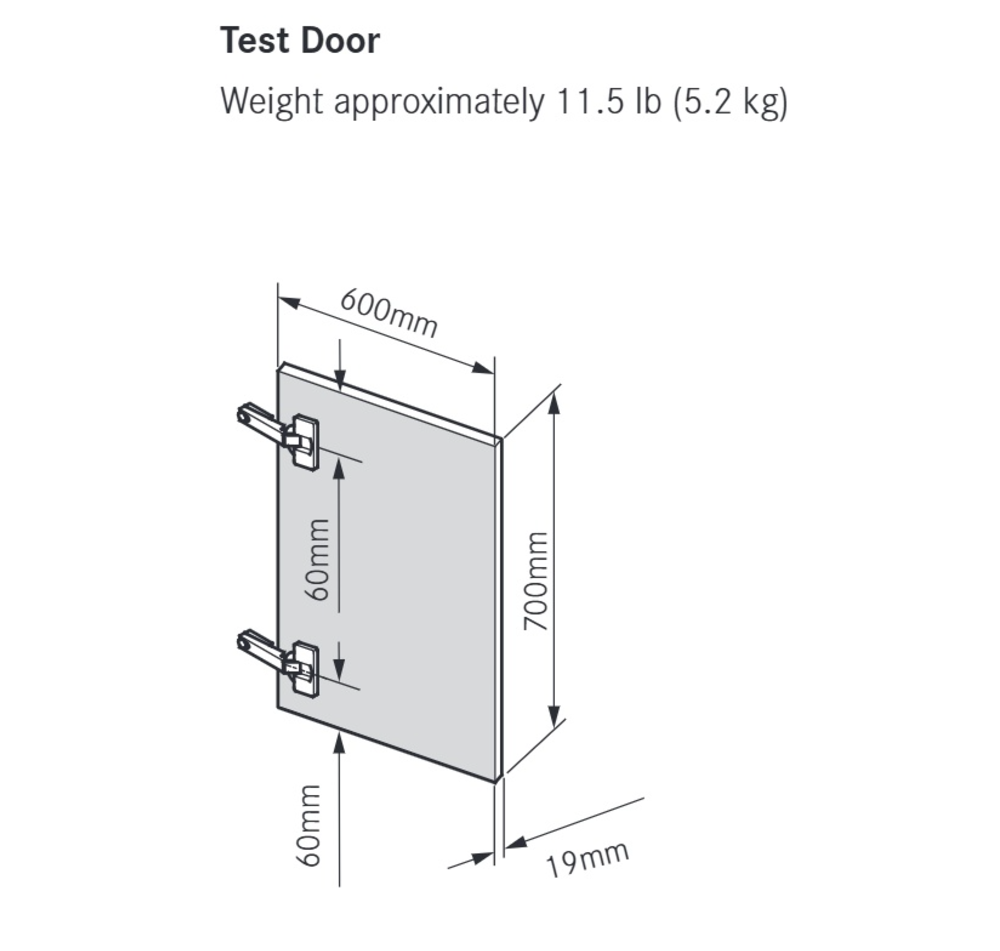
Door height and weight both factor in. Here are the general guidelines directly from Grass TIOMOS technical specs and Salice Silentia+ documentation:
| Door Height | Door Weight | Hinges Needed |
|---|---|---|
| Up to 39″ | 0-20 lbs | 2 |
| Up to 56″ | 20-40 lbs | 3 |
| Up to 84″ | 40-60 lbs | 4 |
| Up to 96″ | 60-80 lbs | 5 |
Table reflects Salice Silentia+ specifications for doors up to 20″ wide. Grass TIOMOS hinge count varies by the interaction of height and weight — consult the Grass technical chart or Wurth Louis & Company for doors near the border of these ranges
One rule applies across all three brands: the distance between your top and bottom hinge must be greater than the width of the door. A tall, narrow door needs hinges spaced further apart, not closer together.
Step 1: Determine Your Cup Hole Centerpoint
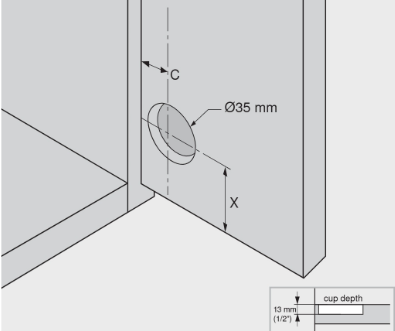
Before you drill anything, you need to know exactly where the center of each cup hole goes. This measurement is called the centerpoint, and it depends on your overlay.
Blum CLIP top BLUMOTION: Use the overlay-to-centerpoint table below, taken directly from the Blum instruction sheet.
| Overlay | Cup Hole Centerpoint from Door Edge |
|---|---|
| 14mm (9/16″) | 20.5mm (13/16″) |
| 15mm (19/32″) | 21.5mm (27/32″) |
| 16mm (5/8″) | 22.5mm (7/8″) |
| 17mm (21/32″) | 23.5mm (15/16″) |
| 18mm (23/32″) | 24.5mm (31/32″) |
Your centerpoint stays the same for every hinge on that door.
Grass TIOMOS: The centerpoint (called Cup Center or CC) is your drilling distance plus half the cup diameter. At a 5mm drilling distance, your centerpoint is 22.5mm (7/8″) from the door edge. Grass recommends a drilling distance of 3-7mm from the door edge.
Salice Silentia+: Use the formula C = 20.5 + K + A, where K is your drilling distance (3-6mm) and A is your reveal. For most standard installs, your cup center will land between 24mm and 27mm from the door edge.
Step 2: Mark Hinge Positions on the Door
Lay your door face-down on a flat surface, hinge side facing you.
Mark your centerpoint line parallel to the hinge-side edge, this is the column of measurements you calculated in Step 1.
Then mark where each hinge sits along the height of the door. Start at least 3 to 4 inches from the top and bottom edges. For a third hinge, center it between the first two.
Use a combination square to make sure your marks are square to the door edge. If your marks are off-square, your door will hang crooked even if everything else is correct.
How to know you did this right: Each mark should be a clear intersection point — one line parallel to the edge, one line measuring in from the edge. That intersection is the center of your drill bit.
Step 3: Drill the Cup Holes
All three brands use a 35mm Forstner bit. Drill depth varies slightly by brand:
- Blum CLIP top BLUMOTION: 13mm (1/2″) deep
- Grass TIOMOS: 12.6mm (1/2″) deep
- Salice Silentia+: 12mm deep
Set your drill depth stop before you start. An easy way to do this is to wrap a piece of tape around the bit at the correct depth. When the tape touches the wood surface, stop drilling.
Keep your drill perpendicular to the door face. If you angle the bit even slightly, the hinge cup will sit crooked and the door will not close flush.
Do not drill through the door face. If you see the bit starting to break through the front, stop immediately.
How to know you did this right: Drop the hinge cup into the hole. The flat rim of the cup should sit flush with the door surface, with no rocking.
Step 4: Attach the Hinge Cup to the Door
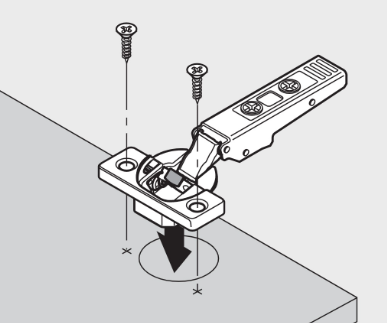
Press the hinge cup into the drilled hole. The front edge of the hinge arm should run parallel to the edge of your door.
Pre-drill two 3mm (1/8″) pilot holes into the screw slots beside the cup. Keep the pilot hole depth shallower than the screw length — for Blum and Grass, that means less than 5/8″ deep.
Drive the included #6 x 5/8″ wood screws to secure the cup. Do not overtighten. The cup should sit flat and stable.
Grass TIOMOS Impresso note: The Impresso version requires no screws to attach to the door. Insert the hinge in the open position with the flap upright. Use your index finger to push the cup straight into the hole. The expanding green brackets lock it in place. The bore hole must be precisely 35mm to 35.1mm for this to work.
Repeat for all hinge positions on the door.
Step 5: Install the Mounting Plates Inside the Cabinet
The mounting plate is the piece that stays screwed to the cabinet wall or face frame. The hinge clips onto it after the door is ready to hang.
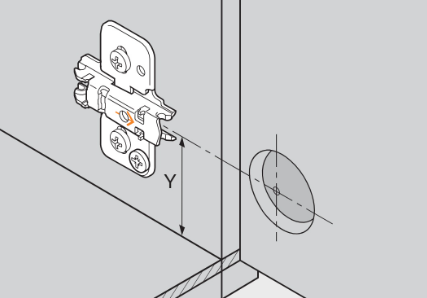
All three brands share one key measurement: the front edge of the mounting plate sits 37mm (1-7/16″) back from the front edge of the cabinet opening. Mark this line on your cabinet wall or face frame before you drill anything.
Finding Your Vertical Position: Worked Example
The height of the mounting plate in the cabinet is calculated with this formula: Y = X minus OL
- Y is where the center of the mounting plate goes, measured from the bottom of the cabinet opening
- X is the distance from the bottom of your door to the center of your bottom hinge cup hole (the measurement you used when marking the door in Step 2)
- OL is how much the bottom of your door overlaps the bottom of the cabinet opening
Here is a real example. Say your bottom hinge cup center is 4 inches up from the bottom of the door (X = 4″). Your door overlaps the bottom of the cabinet opening by half an inch (OL = 0.5″). Subtract: 4″ minus 0.5″ = 3.5″. Your mounting plate center goes 3.5 inches up from the bottom of the cabinet opening. Mark that point on the cabinet wall at 37mm back from the front edge. That is where your plate goes.
Repeat this calculation for the top hinge using the top hinge cup position. All additional hinges follow the same formula.
Pre-drill two 3mm pilot holes at each plate location. For Blum, the two mounting plate screws are 32mm (1-1/4″) apart. Drive the included wood screws to secure the plate.
Blum note: The mounting plate has an arrow printed on top. That arrow must point toward the cabinet opening. Installing it backwards means the hinge will not clip on.
Repeat for all hinge positions in the cabinet.
Step 6: Hang the Door
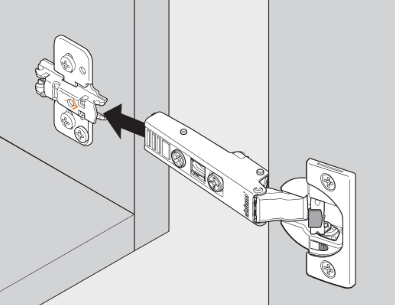
Line up the hinge arm with the center of the mounted plate. On Blum, make contact at point A (the lower tab), then push down firmly at point B until you hear or feel a click. The door is now attached.
On Grass TIOMOS, the ergonomic clip releases with an audible locking sound. If it does not click, the arm is not fully seated — do not force it.
Salice uses a snap-on Domi plate system. The arm slides over the plate and locks in.
Open and close the door a few times before adjusting anything. The hinge needs to settle.
To remove the door for painting or repairs: Open the door fully. Pull the release lever (Blum calls this point A on the arm), then pull the hinge away from the plate. Repeat for all hinges.
Step 7: Make Your Adjustments
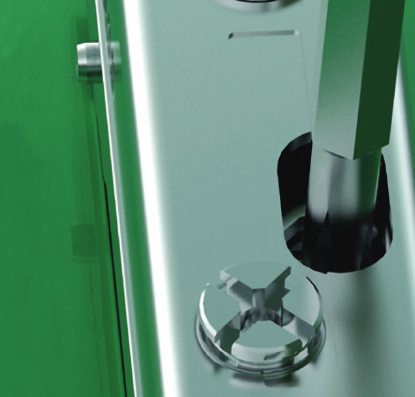
Every concealed hinge from all three brands offers 3-way adjustment. Each screw moves the door in a different direction. Adjust one at a time and check before moving to the next.
| Problem You See | Which Screw | What to Do |
|---|---|---|
| Gap bigger on one side (left/right) | Front screw (side) | Turn to shift door toward or away from hinge side |
| Door sits too high or too low | Middle or mounting plate screw (height) | Turn to raise or lower door |
| Door sticks out from cabinet face | Rear screw (depth) | Turn clockwise to pull door flush |
Adjustment ranges from the spec sheets:
- Blum: Side ±2mm, height ±2mm, depth +3mm/-2mm
- Grass TIOMOS: Side ±2mm, height ±2mm, depth +3mm/-2mm
- Salice Silentia+: Side -1.5mm to +4.5mm (larger range due to patented parallel system), height ±2mm, depth up to +2.8mm
Salice note: Unlike Blum and Grass, the Salice side adjustment maintains a constant reveal of 1.5mm as you move the door. This means the gap between the door and cabinet stays consistent no matter where you position the door side to side.
Use a #2 POZI driver for all adjustments on all three brands. A standard Phillips will work in a pinch but is more likely to slip and strip the cam screws.
Step 8: Set Your Soft-Close Action
All three brands include soft-close as part of the hinge body, not as a separate add-on.
Blum BLUMOTION: Comes pre-activated. If you need to deactivate it, slide the small switch on the hinge cup toward the hinge arm. The door must be closed once for the deactivation to complete. Slide back to reactivate.
Grass TIOMOS: Has three soft-close settings adjusted via a lever on the hinge arm, no tools required.
- Lever pointing toward cabinet wall = light setting (small, light doors)
- Lever parallel to cabinet wall = medium setting (factory default, covers 80% of door applications)
- Lever pointing toward cabinet interior = strong setting (large, heavy doors)
If your door slams at the end of travel, switch to a stronger setting. If it feels like it resists closing, switch to lighter.
Salice Silentia+: Uses twin fluid dampers housed inside the hinge cup itself. The soft-close action is adjusted via a small switch on the hinge body. Adjust the switch to increase or decrease the deceleration speed based on how heavy your doors are.
Troubleshooting Installing Concealed Cabinet Hinges
| What You See | Likely Cause | Fix |
|---|---|---|
| Door not closing flush to cabinet | Cup drilled too shallow | Adjust rear depth screw first; if range is maxed, redrill |
| Gap uneven top to bottom | Hinge height positions differ | Adjust height screw on mounting plate |
| Door drifts side to side over time | Side screw not tightened after adjustment | Tighten all screws after final position is set |
| Soft-close slams at the end | Grass: setting too light / Blum: switch not in active position / Salice: damper setting too light | Adjust soft-close setting per brand instructions above |
| Hinge cup wobbles in hole | Pilot holes too wide or cup bore too large | Check bore diameter — must be within 35mm to 35.1mm |
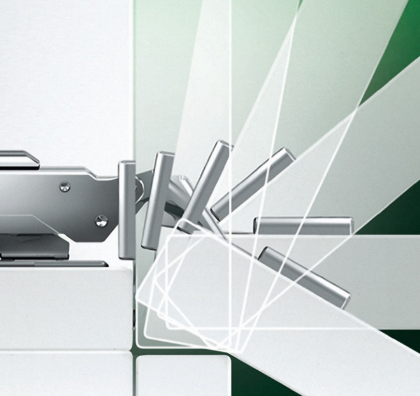
| Door hits adjacent cabinet when opened | Opening angle too wide for your layout | Add an angle reduction clip (Blum: reduces to 85°; Grass: reduces to 85° or 120° depending on hinge model) |
Replacing Old Hinges vs Installing on New Doors
If you are replacing existing concealed hinges with the same brand and series, your old cup holes may be reusable. Check that the cup diameter and screw hole pattern match before ordering new hardware.
If you are switching brands, measure your existing cup depth and drilling distance carefully. Blum’s cup is 13mm deep, Grass is 12.6mm, and Salice is 12mm. These differences are small but matter when the hinge cup needs to sit flush.
For new doors, drill cup holes before painting. Drilling after paint risks chipping the finish at the rim of the hole.
Shop Concealed Hinges at Wurth Louis & Company
Wurth Louis & Company carries Blum CLIP top BLUMOTION, Grass TIOMOS, and Salice Silentia+ in full overlay, half overlay, and inset configurations with soft-close standard.
Dive Deeper into Cabinet Hinges
Soft Close vs Self Close Cabinet Hinges
Cabinet Hinge Degrees: How to Choose the Right Opening Angle
Blum vs Salice vs Grass Hinges